A life lived in the background, but never in the margins
I keep coming back to David Jacob Eisenhower because his life has the plain force of a well-made hinge. It does not ask for attention. It simply holds. In a national story that often shines a spotlight on presidents, generals, and public names, he belongs to the less glamorous architecture underneath them. He was not the headline. He was the timber inside the wall, the structure that lets the house stand through weather.
David Jacob Eisenhower was born into a world that still felt unfinished. Pennsylvania in the middle of the nineteenth century was not a place of easy inheritance. It was a place of family labor, religious continuity, and hard adaptation. When I think about his early life, I do not picture ceremony. I picture a boy growing up inside habits that were already shaping him, habits of discipline, frugality, and movement. His family belonged to the River Brethren tradition, and that matters because belief was not a decoration in such households. It was a daily grammar. It shaped speech, conduct, work, and the boundaries of home.
Migration as a family education
The move to Kansas in 1878 was not just a change of address. It was a lesson in reinvention. Families that crossed that distance carried more than trunks and tools. They carried uncertainty, memory, and hope. Kansas was not a soft landing. It demanded stamina. For David Jacob Eisenhower, the move placed him inside the long American pattern of western settlement, where ordinary families became the builders of towns, roads, and communities that would later be mistaken for inevitability.
That kind of migration changes a person. It teaches that place is not fixed and that identity can be carried like a lantern through dark weather. I think that may be one of the deepest truths about David Jacob Eisenhower. He seems to have understood life as a thing that must be moved with, repaired, and worked on. Not polished. Not admired from afar. Worked on.
Marriage, household life, and the scale of domestic labor
His marriage to Ida Elizabeth Stover in 1885 created the center of his adult life. A family is often described in sentimental terms, but large households are also engines of constant management. They require the logistics of food, clothing, sleep, discipline, and money. They require patience when money runs thin and courage when plans break apart. That was the world David and Ida made together.
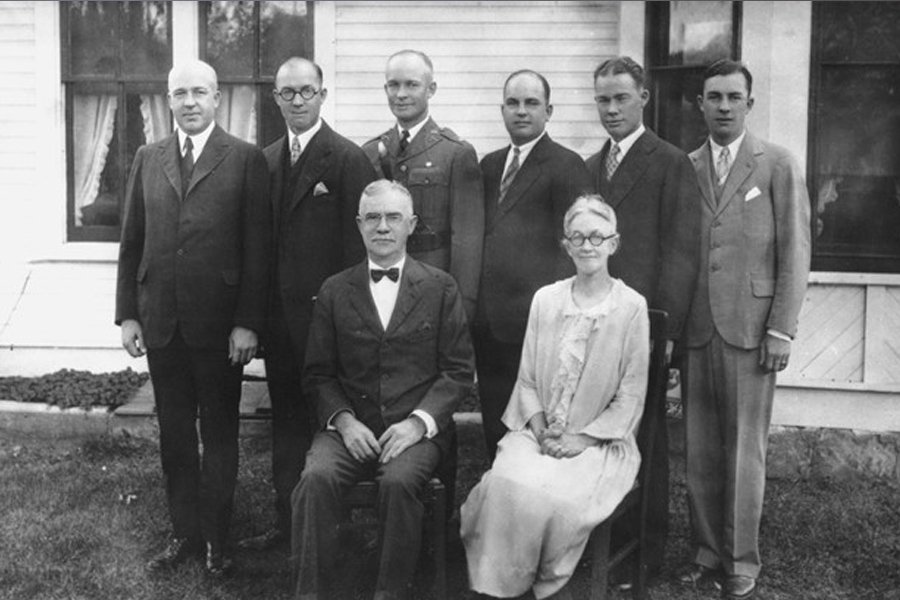
I find it striking that their home became the setting for seven sons, one of whom died in infancy. That detail is small on the page and enormous in life. Every child in such a family changes the balance of the house. Every illness, every birth, every new pair of shoes or extra plate at the table, adds weight to the daily arithmetic. The family was not simply large. It was active, crowded, and always in motion. There is a kind of music in that kind of household, but it is not quiet music. It sounds like boots on floors, voices in hallways, and the rhythm of chores done because they must be done.
What interests me most is not just that David was a father, but that fatherhood in his world was inseparable from provisioning. He was expected to keep the household from slipping. That is a heavy calling. It asks a man to be a provider, organizer, worker, and example all at once. The result is often invisible until much later, when someone famous rises from the same household and the public suddenly asks where the foundation came from.
Work as a language of survival
David Jacob Eisenhower’s work life gives his story a practical texture. He studied engineering at Lane University, and that detail matters more than it might seem at first. Engineering suggests a mind drawn to systems, mechanics, and order. It suggests that he was not simply drifting through jobs but leaning toward work that involved structure and technical understanding.
He and Milton Good opened a general store in Hope, Kansas, in 1885, and the failure of that venture is one of the most revealing moments in his life. Failure has a way of stripping away ornament. It leaves only response. Some people are broken by it. Others learn to move through it. David appears to have chosen the second path.
After the store failed, the family did not vanish into defeat. They moved on, including a period in Texas before returning to Kansas. That kind of movement often gets flattened into a family legend, but I think the more important point is simpler. He kept going. He did not let one failed enterprise define the shape of the rest of his life.
Later work at Belle Springs Creamery, railroad related labor, engine cleaning, and supervisory or technical roles shows a man who adapted without losing his footing. His labor shifted from physical endurance to skilled technical responsibility. That arc matters. It tells me that David Jacob Eisenhower did not merely survive the industrial age. He learned to inhabit it.
The father behind a constellation of sons
The sons of David and Ida each carried the family forward in different directions, and that is one of the most interesting things about his legacy. A lesser story would reduce the family to one famous child. But the larger truth is far more interesting. David and Ida raised a household that generated several distinct adult lives.
Arthur Bradford Eisenhower, Edgar Newton Eisenhower, Dwight David Eisenhower, Roy Jacob Eisenhower, Earl Dewey Eisenhower, and Milton Stover Eisenhower each became part of a different chapter of American life. Dwight became the most visible, but visibility should not be confused with importance. Arthur built his own path. Edgar had his own family and course. Roy lived a different trajectory. Earl and Milton each carried the family name into new settings. Even the son who died in infancy belongs to the story because family memory is made of both presence and loss.
I think the deeper significance here is that David Jacob Eisenhower did not produce a single prodigy in isolation. He helped shape a family culture. The sons were not identical branches. They were different limbs on the same tree, each reaching toward a separate patch of sky. That is a stronger inheritance than fame alone.
Faith, discipline, and the shape of character
The River Brethren background gives David’s story a moral framework. It helps explain the simplicity often associated with his family life. In such communities, restraint was not emptiness. It was discipline. Work was not a punishment. It was a duty. Home was not a stage. It was a field of service. That way of living tends to produce people who are steady under pressure, people who do not expect applause for being responsible.
I find that especially important because it changes how I read his son Dwight’s later public life. Great public figures rarely appear fully formed. They come from households with invisible rules, repeated habits, and deeply internalized ideas about duty. David Jacob Eisenhower helped create that atmosphere. He was part of the machinery behind the visible history.
I do not mean that in a cold way. I mean it with admiration. There is dignity in the uncelebrated labor of making a family stable enough to launch children into the world. That labor can feel like carrying water uphill every day, but it is often what history rests upon.
Memory, legacy, and the long echo of ordinary work
David Jacob Eisenhower died in 1942 in Abilene, Kansas, but the shape of his life remained visible long after. The public remembers the famous son, yet I think the father deserves his own careful attention because he represents a larger American pattern. He stands for the people who build without being noticed, who move when they must, who absorb loss without becoming broken by it, and who make a home out of scarcity.
What I find most compelling is that his life resists dramatic ornament. It does not need embellishment. It has the clean grain of something made from real wood, not painted imitation. He was a migrant, a husband, a father, and a worker. He belonged to a religious tradition that valued discipline. He endured business failure. He adapted to new kinds of labor. He helped raise a family that would leave a deep mark on American history.
FAQ
Who was David Jacob Eisenhower?
David Jacob Eisenhower was an American man born in Pennsylvania who later settled in Kansas, where he built a life centered on family, labor, and religious conviction. He is best known today as the father of Dwight D. Eisenhower, but his own life reflects the broader story of working families in the American Midwest.
What shaped David Jacob Eisenhower’s early life?
His early life was shaped by a large family, River Brethren faith, and the experience of migration. Those forces gave him a practical outlook and a strong sense of duty that seems to have stayed with him throughout his adult life.
What kind of work did David Jacob Eisenhower do?
He worked in a range of practical jobs, including storekeeping, railroad related labor, creamery work, and technical or supervisory positions. His engineering studies suggest that he was interested in systems and mechanics, not just manual labor.
Why is his marriage to Ida Elizabeth Stover important?
Their marriage formed the center of his adult life. Together they built a large household, raised seven sons, and created the family environment that shaped the next generation, including Dwight D. Eisenhower.
How many children did David Jacob Eisenhower have?
He had seven sons. One died in infancy, and the others grew to adulthood and went on to build their own lives in different directions.
Why does David Jacob Eisenhower matter historically?
He matters because he represents the hidden foundation behind public achievement. His life shows how labor, faith, migration, and family discipline can shape history even when the person living that life remains outside the spotlight.
Choosing The Right Stay For The Way You Travel
Building A Va Disability Claim That Survives A Close Review
How To Choose A Roof That Thrives By The Ocean